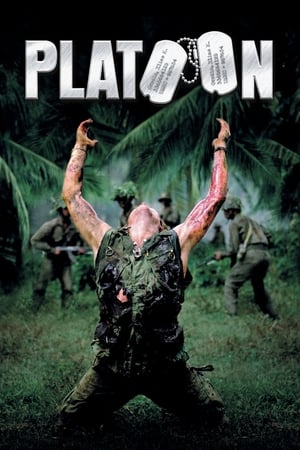
Platoon (1986-12-19)
Drama | War | Action |
Overview
Directed By: Oliver Stone
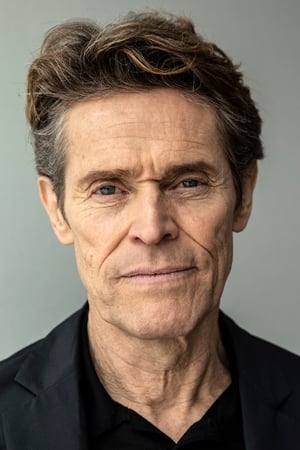
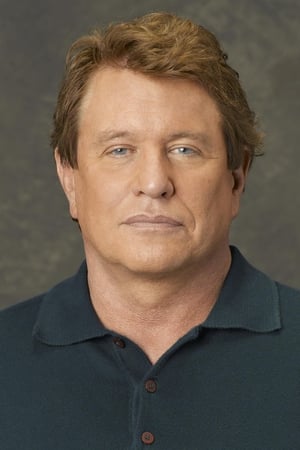
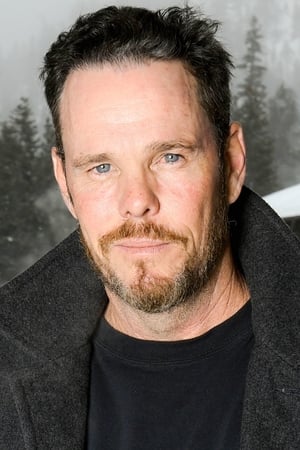
Star Cast: Charlie Sheen , Willem Dafoe , Tom Berenger , Kevin Dillon ,
Videos Playlist
Similar Collection

Images




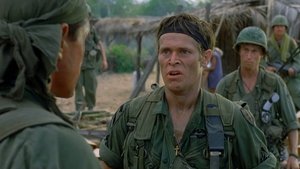
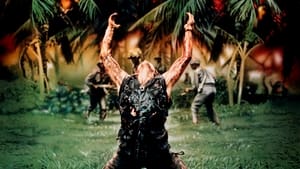













-
tricksy
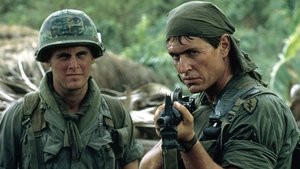
Platoon is a must see. The film that put Stone on the map, Platoon is considered by Vietnam Vets as the most realistic. But in keeping the maxim of giving credit where credit is due, much of the success of Platoon belongs to military adviser Captain Dale Dye, who has been linked to pretty much every great war movie in the last twenty years. Much accolades to Tom Berenger as well, whose performance as Sgt. Barnes is the tour de force of his career. With a great script, great performances, and awesome cinematography, Platoon is a surefire classic.
-
Filipe Manuel Neto
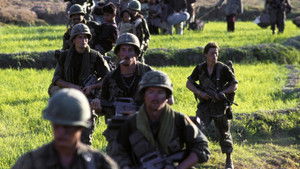
**A film with a good script and good characters, but which exaggerates some things and is as anti-war as almost all films about Vietnam.** The Vietnam War is one of the most brutal conflicts the US was involved in the 20th century, and one of the first wars that Americans lost. Following the expulsion of the Japanese and the end of French colonization in the region, the effort to help democratic South Vietnam to survive the invasion by its northern neighbor, a pawn at the orders of the USSR, resulted in a bloodbath that it leaves dents in the American mentality. That's why there are several films about this war, and the vast majority are highly critical of US intervention. This film is just another one and brings us a story that is not very different from what we can see in “Apocalypse Now” or “Full Metal Jacket”. Charlie Sheen gives us what we can consider his best and most solid effort as an actor. In addition to looking appropriately unprepared, like an ordinary kid who goes to a war he's not ready for, he makes a poignant dramatic effort and gives the character a well-done psychological evolution. However, the film also features two great actors who achieved a deserved highlight: Tom Berenger and Willem Dafoe. They give life to two totally antagonistic characters who, with their conflict, almost jeopardize the operational viability of their combat group. The film also stars Forrest Whitaker, Keith David and an extremely young Johnny Depp. Technically, the film has extremely solid points. Skillfully directed by Oliver Stone, who gives us one of the most intense and consistent works in his cinematographic work, the film was made in very good locations and manages to give us all the realism and tension we could want in a war film. The second part is particularly brutal, with very intense combat scenes, a lot of blood and scenes not suitable for impressionable people. I even dare to say that it is not a suitable film for anyone who has been in combat and has been left with psychological problems. The cinematography is deeply atmospheric, with a creative use of light, cloudiness, fog and vegetation, and very intelligent framing. The soundtrack features several deeply atmospheric themes, of which I highlight Samuel Barber's Adagio, one of the most poignant melodies in the classical repertoire. The script is also full of qualities. Amid all the brutality and the usual messages about the futility and inhumanity of war, common to most films about Vietnam, a plot of bloody rivalry develops between two sergeants from the same platoon: one is a man with leadership skills who is determined to carry out the mission without allowing himself to commit unjustified excesses and brutalities; the other is a worn-out veteran who doesn't mind massacring everything he touches to do the thing. Obviously, things become unsustainable and soldiers' loyalties are divided, something that would be unacceptable in a military unit. It's good to see this, the rivalry gives more flavor to the film, even though it is completely absurd if we consider how much the military values obedience and the chain of command. In addition to all this, the film also divagates a lot about the use of drugs as a way of escaping the reality. This actually happened, and it was not uncommon to give soldiers exciting substances so that they could more easily withstand the hardships of combat, but it seems to me that the film goes beyond what is reasonable. Oliver Stone exaggerates in his portrayal, which is no surprise considering the films he has directed.
-
CinemaSerf
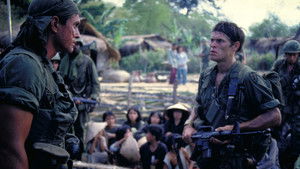
The corn at home might have been green, but nowhere near as green as “Chris” (Charlie Sheen) when he arrives in Vietnam ready to take up arms against the well entrenched Viet-Cong. The scene as he arrives speaks volumes as his far most experienced colleagues look upon his fresh face with a combination of resentment and disdain, and he is posted to a squadron run by an equally inexperienced lieutenant (Mark Moses). Luckily the heavy lifting is done by a staff sergeant “Barnes” (Tom Berenger) and by “Sgt. Elias” (Willem Dafoe). The former is a bit of a brute of a man, battle-scarred and ruthless whilst the latter is equally formidable but in a less hostile fashion. The experiences of “Chris” and his platoon soon showcase the worst excesses of jungle warfare against a foe entirely adept, and of course this takes it’s psychological toll on these men as they climb, scramble and crawl inch-by-inch through the foliage. Their arrival in a small village sees them so desperate for information that “Barnes” takes the law into his own hands, much to the furious disgust of “Elias” and what follows now sees the men polarised and conflicted. There is no time for hearings, and so back into the battle they go but this time the enemy for “Chris” isn’t only wearing a VC uniform. The frequent use of the refrain from Samuel Barber’s “Adagio for Strings” contrasts potently with the scenes of indiscriminate slaughter on the ground and from the air as these young men, from a variety of backgrounds and educations, have to deal with the horrors of war first hand. The impact isn’t just a physical assault on these lads but as the fear takes hold; the lack of sleep impacts on their judgment and every crack or crunch from their hot and claustrophobic environment raises alarm bells, they become nervous wrecks whose own codes of honour become compromised by the more visceral need to survive - and Oliver Stone creates a series of scenarios that powerfully capture something of their circumstances whilst bluntly inviting us watching to take a view on the ghastliness of modern warfare. The most precious thing they have is their lives, and the longer they are there the more they realise how unimportant and temporary lives can be. For me, it was probably Berenger who took the acting plaudits, but right across the board there are strong and convincing performances that work with an intensive cinematography to remind, compellingly, that many of those fighting were no more professional soldiers than had fought in France twenty years earlier, and that the human race hadn't learned much more since then other than to ensure it's weaponry was even more destructive.